
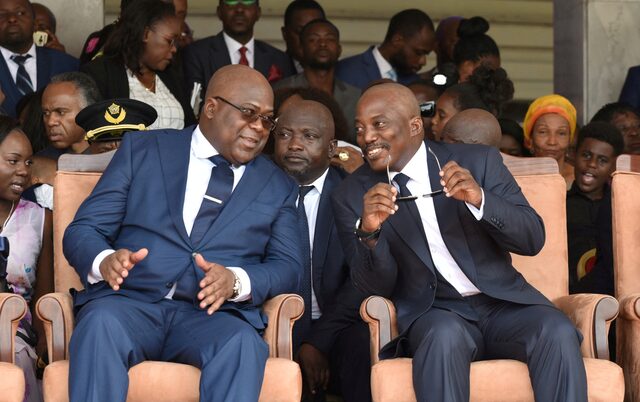
Former Congolese President Joseph Kabila has initiated talks with opposition leaders and civil society figures amid escalating violence in eastern Congo, where M23 rebels—allegedly backed by Rwanda—continue to gain ground, five sources familiar with the discussions told Reuters.
The outreach raises new political challenges for President Félix Tshisekedi, who has faced criticism over his handling of the crisis. Tshisekedi recently accused Kabila of sponsoring the M23 insurgency—a claim the former president did not publicly address until a February 23 op-ed, in which he accused his successor of constitutional violations, human rights abuses, and bringing Congo to the brink of civil war.
Sources close to Kabila describe his private conversations as scathing, with one individual who spoke to him directly saying, “The Tshisekedi regime is soon over.” While discussions have touched on the possibility of a political transition, no concrete plan has emerged.
Kabila, who has remained largely behind the scenes since stepping down in 2019, has previously met with opposition leaders, including Moïse Katumbi and Claudel Lubaya, in Addis Ababa last December. Lubaya told Reuters that “the sky is grey and the outcome uncertain for the country since Tshisekedi seems more concerned with retaining power than finding a solution.”
Meanwhile, tensions between Tshisekedi’s government and Kabila’s camp continue to rise. Congolese authorities reportedly blocked a boat owned by Kabila on suspicion that it was transporting weapons to groups aligned with M23—a claim Kabila’s allies deny.
As the crisis unfolds, Tshisekedi has announced plans for a unity government, though details remain unclear. In contrast, Kabila, speaking this week in Namibia, called for an inclusive peace process but remained vague about his own ambitions. “Only God knows,” he said when asked about his future role, adding that his goal is to “serve our country, serve our people.”
With armed groups advancing and political tensions rising, Congo faces a volatile period ahead—one that could reshape its leadership and stability.