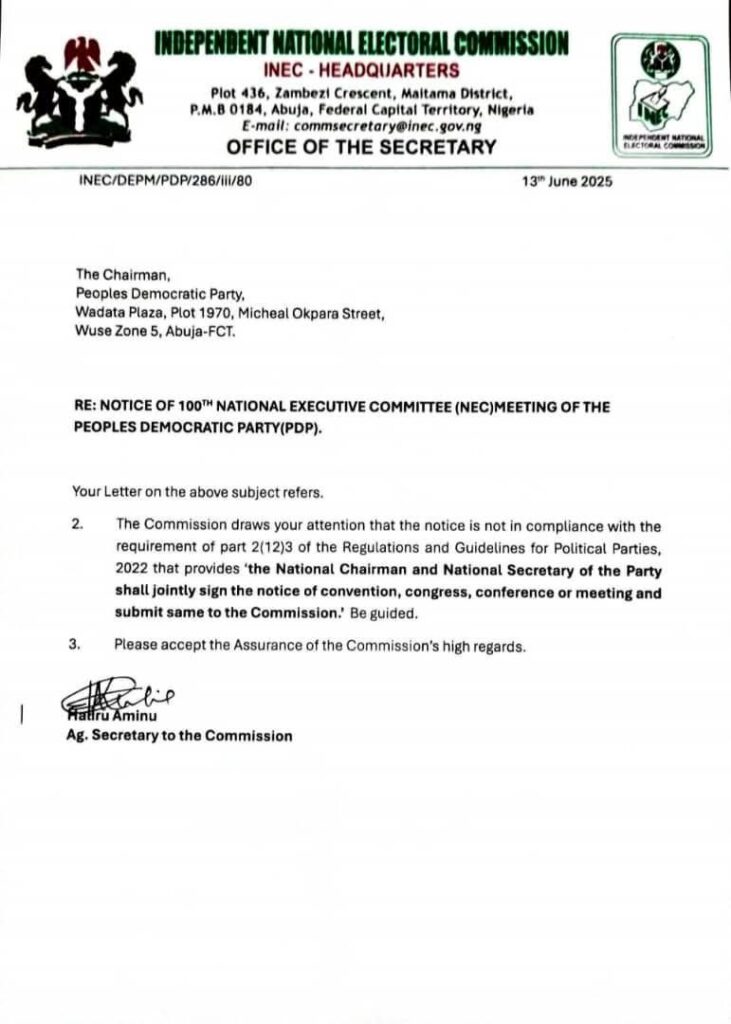
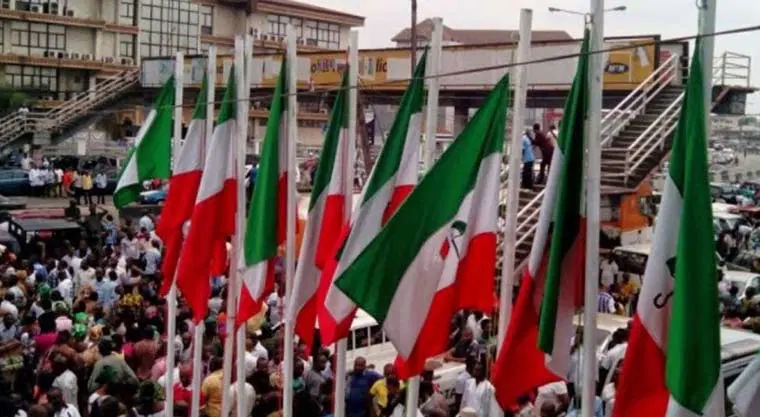
In a development that may further deepen the ongoing internal crisis within the Peoples Democratic Party (PDP), Nigeria’s electoral umpire, the Independent National Electoral Commission (INEC), has formally rejected the notice for the party’s planned 100th National Executive Committee (NEC) meeting, citing procedural irregularities and non-compliance with existing regulations.
In a letter dated June 13, 2025, addressed to the Chairman of the PDP at its national headquarters in Abuja, INEC stated that the submitted notice was defective as it did not meet the mandatory requirements stipulated in the Regulations and Guidelines for Political Parties, 2022.
According to the letter signed by Hajiiru Aminu, Acting Secretary to the Commission, INEC reminded the PDP leadership of the specific provision contained in Part 2(12)3 of the regulations which clearly stipulates that: “the National Chairman and National Secretary of the Party shall jointly sign the notice of convention, congress, conference or meeting and submit same to the Commission.”
INEC’s correspondence implies that either one or both of these required signatures were absent from the document submitted, thereby rendering the notice invalid in the eyes of the Commission. The Commission, while urging the party to be guided accordingly, emphasized that compliance with this statutory provision is not optional but obligatory for all political parties operating within Nigeria’s electoral system.
Implications for PDP’s Leadership and Factional Disputes
The Commission’s latest intervention comes at a delicate time for the PDP, which has been embroiled in a protracted leadership struggle, with multiple factions laying claim to the control of key party organs and administrative functions.
Observers note that this procedural rejection by INEC may serve to embolden one faction while further weakening the position of another. The absence of joint signatures from the recognized National Chairman and National Secretary raises questions about who precisely authorized the notice for the NEC meeting and whether such authorization had the full backing of the party’s constitutionally recognized leadership.
Sources within the party suggest that the controversy may be linked to the lingering leadership disputes, including court cases and conflicting directives that have divided the PDP’s National Working Committee (NWC) in recent months. The NEC meeting in question was widely expected to address some of these internal divisions, including discussions on reconciliation, party reforms, and the preparation for upcoming off-cycle elections and the 2027 general elections.
INEC’s Growing Role in Internal Party Governance
This development also underscores INEC’s increasingly assertive role in regulating internal party affairs, particularly as it relates to compliance with constitutional and statutory frameworks governing political parties in Nigeria. Over the years, INEC has repeatedly insisted that political parties must adhere strictly to their internal constitutions and the broader regulatory framework as a condition for recognition of their decisions and activities.
Analysts note that the PDP’s situation reflects a wider trend in Nigerian politics where internal party disputes often translate into legal and procedural battles that attract regulatory scrutiny from INEC and, in many cases, lead to protracted litigation.
What Next for PDP?
For now, the PDP leadership will have to quickly resolve the procedural defects highlighted by INEC if it intends to convene its NEC meeting legitimately. Failure to comply may expose any decisions taken at such a meeting to legal challenges, both internally and externally.
As the 2027 electoral calendar gradually takes shape, political stability within the PDP remains a critical factor for its readiness to compete effectively on the national stage. The current debacle adds yet another layer of complexity to the party’s efforts at internal reconciliation and strategic repositioning.
INEC’s letter has once again placed the ball squarely in the court of the PDP’s warring factions. Whether the party can overcome its internal differences and comply with the statutory provisions remains to be seen.