
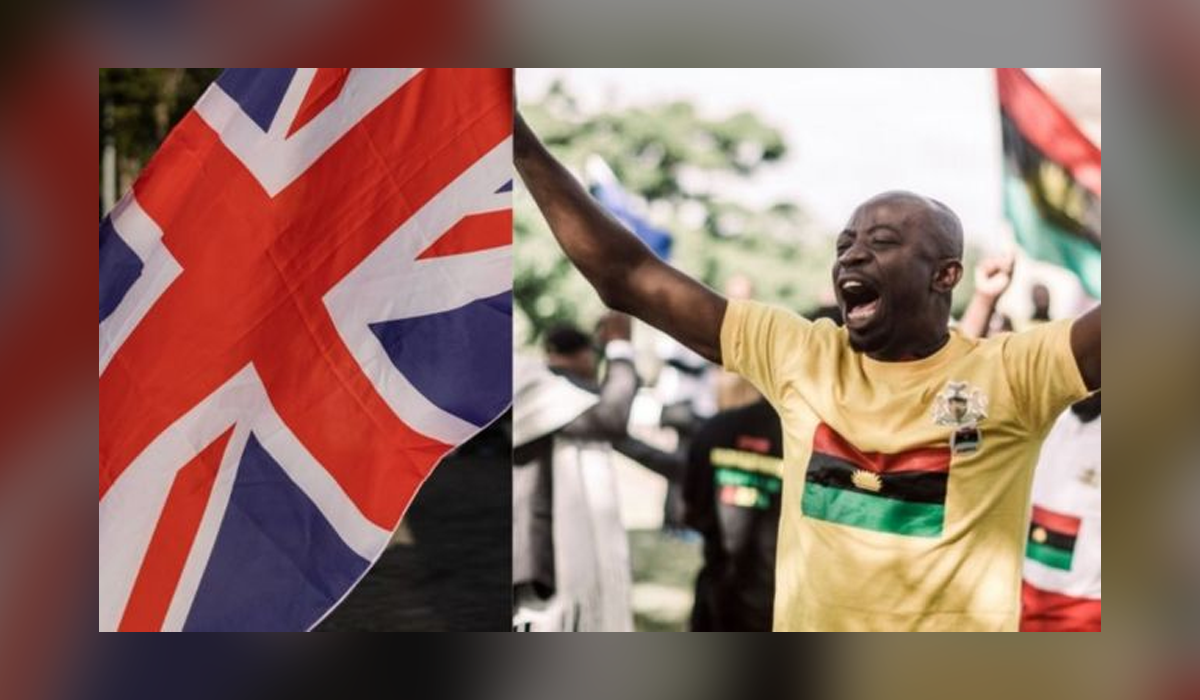
The Indigenous People of Biafra (IPOB) have been designated as a terrorist organization and a group that uses violence to achieve its goals by the United Kingdom.
This was disclosed in the United Kingdom Visas and Immigration office’s May 2022 policy update.
UKVI clearly identified IPOB, whose leader, Nnamdi Kanu, is currently in the custody of Nigeria’s Department of State Services (DSS), as a terrorist organization to be excluded from its asylum programme for violent crimes committed in Nigeria’s South East.
“The Nigerian government has designated the IPOB as a terrorist organization, and members of the group and its paramilitary wing – the Eastern Security Network (established in December 2020) – have allegedly committed human rights violations in Nigeria,” UKVI stated in its policy notes.
“If a person has been involved with IPOB (and/or an affiliated group), MASSOB, or any other ‘Biafran’ group that incites or uses violence to achieve its goals, decision-makers must consider whether one (or more) of the exclusion clauses under the Refugee Convention applies.”
“Asylum should not be granted to people who violate human rights.”
The Nigerian government designated IPOB as a terrorist organization in 2017.
In recent times, the proscribed group has been accused of carrying out violent attacks in the South East in order to achieve its secession agenda, but IPOB has repeatedly denied responsibility for the attacks.
Ivan Sheehan, the executive director of the University of Baltimore’s School of Public and International Affairs, recently asked the US government to designate the group as a terrorist organization.
The establishment of the Eastern Security Network (ESN) by IPOB, according to Sheehan, marked the end of the group’s “pretensions of being a peaceful movement.”
The American academic also accused IPOB leader Nnamdi Kanu of terrorism and issuing threats through Radio Biafra.
“IPOB leader Nnamdi Kanu appears unconcerned. “It is troubling that he feels no need to conceal his support for terrorism,” Sheehan wrote.
“Through its online platform, ‘Radio Biafra,’ and other social media platforms, IPOB has increasingly used inflammatory rhetoric to encourage secessionist aspirations and resistance to the authorities, including violence” (see Overview of groups, Movement for the Actualization of the Sovereign State of ‘Biafra’ (MASSOB), and Separatist groups outside of Nigeria).
“According to sources, security forces arrested hundreds of IPOB supporters at various events, particularly between 2015 and 2017, including raids on IPOB leaders’ homes.” Since 2015, IPOB has also claimed that security forces used excessive force, killing and injuring hundreds of its supporters (see Indigenous People of ‘Biafra’: Clashes between State and Secessionist Groups and Treatment of IPOB).
“In addition, several sources reported clashes between IPOB and authorities in 2018 and 2019.” Further clashes and violence erupted between security forces and IPOB in the city of Enugu in August 2020, and in Rivers State in October 2020. There were reports in November 2020 that security forces carried out operations against IPOB in Rivers State’s Oyigbo area. However, state governor Nyesom Wike denied the reports. These incidents resulted in the arrest and death of IPOB supporters as well as security personnel (see Indigenous People of ‘Biafra’: Clashes between State and Secessionist Groups and Treatment of IPOB).
“In December 2020, IPOB is said to have established the Eastern Security Network (ESN), a paramilitary force (see Overview of groups, Movement for the Actualization of the Sovereign State of ‘Biafra’ (MASSOB), and Separatist groups outside of Nigeria).”
“In February 2021, the Nigerian military launched land and air operations against ESN operatives (see Aims, Activities, Indigenous People of ‘Biafra’: Clashes between state and secessionist groups, and IPOB Treatment).”
“Disputes between IPOB and the authorities raged on into 2021.” The group was involved in attacks reported to have occurred in Imo State in April 2021, where a police headquarters was destroyed and over 1,800 prisoners were reported to have escaped from a prison, though IPOB denied involvement in the attacks. Clashes between state security forces and IPOB in May 2021 resulted in the deaths of both IPOB/ESN members and security forces. According to sources, the Nigerian Army stated in June 2021 that IPOB/ESN had killed 128 military and police officers, 15 Civil Defence officers, 31 community policing members, and over 100 people for not supporting IPOB. Nnamdi Kanu, the leader of IPOB, denied this claim. Clashes between state security forces and the IPOB/ESN raged on into the second half of 2021 and into 2022. According to media reports, 11 security forces were killed in June 2021, with another 22 killed between October and December 2021 (see Aims, Activities, Indigenous People of ‘Biafra’: Clashes between state and secessionist groups, and Treatment of IPOB).
“Following an attack on police stations in Rivers State by IPOB members in October 2020, the governor offered a reward for information leading to the arrest and prosecution of IPOB state leader Stanley Mgbere.” In response, Kanu publicly issued a N100m (c. £170-175,000) bounty on the governor. The sources consulted by CPIT yielded no additional information indicating that Mr Mgbere had been located and arrested.
Two unnamed suspected senior IPOB leaders were reportedly arrested in Rivers State in November 2020. (see Clashes between state and IPOB and Bibliography).
“In addition to arrests of IPOB supporters/armed activists, a number of IPOB senior members have been detained, including IPOB leader Nnamdi Kanu, who was jailed for two years in 2015 and then released on bail.” Kanu fled Nigeria while on bail after a clash with soldiers at his home in Abia state in 2017. He was facing terrorism and incitement charges. In June 2021, the Nigerian government announced that he had been arrested in a third country and had been returned to Nigeria. Kanu is still detained in Nigeria and is facing legal proceedings (see Arrest and detention).”