
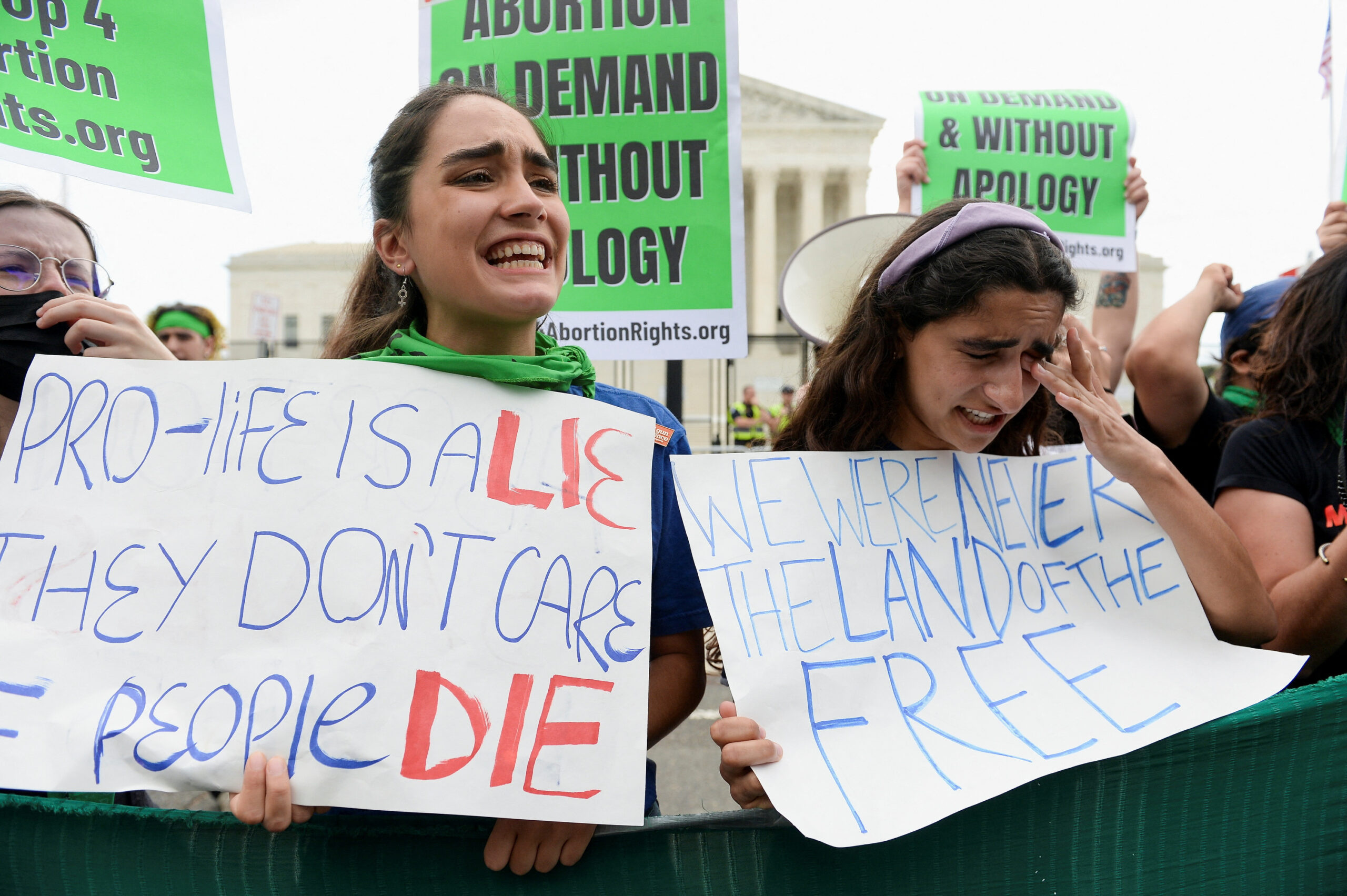
Following a Supreme Court decision on Friday that eliminated American women’s constitutional right to abortion, clinics have started closing in some US states.
After the court overturned its 50-year-old Roe v. Wade ruling, about half of the states are anticipated to enact new limitations or prohibitions.
Additionally, there are so-called trigger laws in place in 13 states that will outlaw abortion in 30 days.
The decision was called “a tragic error” by President Joe Biden.
After pro-choice protesters pounded on the state capitol’s doors and windows in Phoenix, Arizona, police opened fire with tear gas. Protesters briefly stopped highway traffic in Los Angeles.
On Saturday, protests are anticipated to continue in numerous cities across the nation.
As soon as the court’s decision was published online, the doors to the patient area at an abortion clinic in Little Rock, Arkansas, a state with a so-called trigger law that permits an immediate ban—shut, t he staff called the women to inform them that their appointments had been canceled.
No matter how well we prepare for bad news, when it does arrive, it does so with great force. It is heartbreaking to have to call these patients and inform them that Roe v. Wade has been overturned, nurse Ashli Hunt told the BBC.
The clinic’s escorts, who stood in the heat of Arkansas all day long to accompany patients through the crowd of protesters, hugged collectively. “I had assumed that this nation would still value its citizens. Would still have a heart for women,” the lead escort, Miss Karen, said.
Protesters opposed to abortion rejoiced outside.
People who were still parking their cars at the clinic and were unaware of the decision were yelled at by a protester, “You are on notice! ” “My recommendation is that you turn around and leave this sinful, unfair, and evil place.”
One of only three abortion clinics in the state, the Women’s Health Care Centre in New Orleans, Louisiana—another state with a trigger law—was closed on Friday and its staff had left for home.
While wealthy women would still be able to access abortions in other states, “poor women will end up in a back alley” for illegal procedures, volunteer escort Linda Kocher told the BBC from outside the clinic. Pastor Bill Shanks, an anti-abortion activist, however, declared it a “day for celebration.”
According to research from Planned Parenthood, a healthcare organization that performs abortions, the Supreme Court decision is anticipated to result in about 36 million women of reproductive age losing access to abortion in their states.
Anti-abortion activists celebrated the decision outside the court in Washington, but demonstrations against it were planned for Friday in more than a hundred cities, with more expected throughout the weekend.
Despite the fact that abortion is a contentious topic in the US, a recent Pew survey found that 61 percent of adults believe it should always be legal or almost always be illegal.
Tere Harding, an anti-abortion activist in San Antonio, Texas, said she was putting together a security plan in case protesters targeted the crisis pregnancy center she manages outside of the city.
As she listened to Mr. Biden criticize the Supreme Court ruling, she told the BBC that “every human life needs to be protected.” It stands for our recognition of the humanity of the unborn.
Mr. Biden claimed that the decision endangered the lives and health of women.
He described it as “the realization of an extreme ideology and a tragic mistake by the Supreme Court.”
In addition to protecting women’s access to contraception and drugs to end pregnancies of up to 10 weeks that are used to treat miscarriages, he pledged to fight to prevent state and local officials from preventing women from traveling to states where abortions are legal.
The Supreme Court’s own legal precedent was completely overturned by Friday’s decision, an extremely uncommon action that is likely to ignite bitter political conflicts across the country.
California, Washington, and Oregon’s governors have vowed to protect abortion patients who are traveling from other states.
Election by election could decide whether the procedure is legal in states with sharply divided views on abortion, such as Pennsylvania, Michigan, and Wisconsin. In other cases, the decision could spark a fresh round of legal disputes, such as those involving the legality of out-of-state abortions and mail-order abortion drugs.
Meanwhile, former Vice President Mike Pence, a long-time opponent of Roe v Wade, urged anti-abortion activists not to give up until “the sanctity of life” is protected by law in every state.
How the choice was made
The Supreme Court ruled by a vote of seven to two in the landmark Roe v Wade case in 1973 that a woman’s right to terminate her pregnancy was protected by the US constitution.
The ruling guaranteed American women the right to an abortion during the first three months of pregnancy, but it allowed for restrictions in the second trimester and prohibitions in the third.
However, anti-abortion rulings have gradually reduced access in more than a dozen states in the decades since.
The Supreme Court was currently hearing Dobbs v Jackson Women’s Health Organization, a case that challenged Mississippi’s 15-week abortion ban.
The conservative-majority court effectively ended the constitutional right to abortion by ruling in favor of the state.
Five justices strongly supported the nomination: Samuel Alito, Clarence Thomas, Neil Gorsuch, Brett Kavanaugh, and Amy Coney Barrett.
In a separate opinion, Chief Justice John Roberts stated that, while he supported the Mississippi ban, he would not have gone any further.
Stephen Breyer, Sonia Sotomayor, and Elena Kagan, the three justices who voted against the majority, wrote that they did so “with sorrow – for this court, but more so for the many millions of American women who have today lost a fundamental constitutional protection.”
The overturning of a long-standing precedent has also raised concerns about other rights upheld by the Supreme Court in the past.
In his opinion, Justice Clarence Thomas stated, “In future cases, we should reconsider all of this Court’s substantive due process precedents, including Griswold, Lawrence, and Obergefell,” referring to three landmark decisions on the right to contraception, the repeal of anti-sodomy laws, and the legalization of same-sex marriage.