
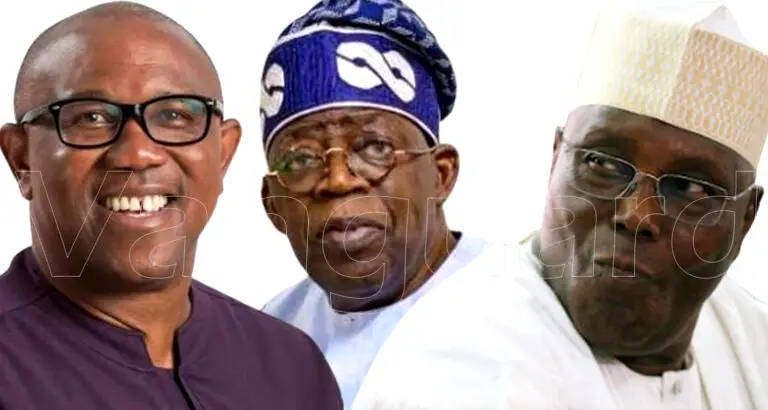
Atiku Abubakar, the Peoples Democratic Party (PDP) presidential candidate, and his running mate, Ifeanyi Okowa, were both absent from the Voice of Women (VOW) 2022 Conference and Awards on Tuesday in Abuja.
The event gave presidential candidates and their running mates the opportunity to explain their plans and commitments to Nigerian women.
The MacArthur Foundation is supporting the VOW2022 initiative of Women Radio 91.7fm and the Voice of Women Empowerment Foundation.
Though the All Progressives Congress (APC) presidential candidate, Asiwaju Bola Tinubu, was not present, his running mate, Kashim Shettima, who represented him, assured Nigerian women that the Asiwaju administration will be friendly to them if elected in 2023.
Peter Obi, the Labour Party’s presidential candidate, promised to support the passage of a new law requiring the reservation of a certain percentage of all elective and appointive positions for women and youths.
APC promises female-friendly leadership.
Shettima stated that the APC would make equity and fairness to women a top priority of the Asiwaju Tinubu administration.
According to him, “The Asiwaju administration will be a government that will be friendly to women. They are the backbone of our society because they constitute over 50% of our total population.
“If Nigeria will reach its full fullest potential, we must give every person and segment of the population a fair chance to make their best contribution to the well-being and betterment of our nation.
“The growth of our economy and achievement of our nation and destiny rests on equity and the safeguarding of the fundamental rights and decency in our society. This means ending all forms of divisive biases, including gender discrimination,” Shettima said.
Obi’s Take
Obi, for his part, stated that the country is collapsing, but women can make a significant contribution to saving it.
He recalled how the women in his cabinet contributed to his success as governor of Anambra, saying they were more productive than the men.
He stated,“You mothers are the ones that will suffer more if things go wrong. Me, I believe in women and I believe they can save the country.
“As Anambra governor, I had a female deputy. My chief of staff was a woman. My commissioners for planning, local government affairs, education, and finance were women, including the State Accountant-General in my tenure was also a woman.
“Women were far more productive than the men. Today, I will attribute my success as a governor to those women in my cabinet. They were brave enough to say to me on many occasions ‘No, you can’t do this because children are involved.’
“For me, women are critical in the efforts to move the country forward. If we want to make progress, we have to surround ourselves with the 50 per cent of our population that we are neglecting, but I am going to invest in women.
“What we are going through today is the cumulative effects of leadership failure. We are now about to pick a new leadership.
“We must go beyond all the considerations of yesterday, and think about the future of this country. We can’t do it without women in the driving seat.
“We need to make a law giving women and youths a certain percentage of all elective and appointive positions like in Bangladesh.”
Aisha Buhari speaks
Meanwhile, the President’s wife, Aisha Buhari, has stated that the role of women in the electoral process cannot be overstated, and she has warned political parties against gender discrimination.
Mrs Buhari, who was represented by Rukkayat Gurin, Senior Special Assistant to the President on Administration and Women Affairs in the First Lady’s Office, said: “Our participation in this election is necessary. I encourage every political party to support women and shun electoral violence against them.
“Nigerian women are competent and have the capability to serve. I want to reaffirm to you that the government of Muhammadu Buhari, is committed to making the 2023 electoral process credible and violence-free,” she added.
Why gender equity, balance is a herculean task for political parties – INEC
In his keynote speech, Prof. Mahmood Yakubu, Chairman of the Independent National Electoral Commission, INEC, explained why achieving success in encouraging gender equity and balance within political parties had become a herculean task.
He claimed “Until there’s an enforceable legislation that is gender responsive in terms of their leadership structure as well as policies and practices, the political parties may be limited to just sustaining engagements, advocacies, moral persuasions and capacity building programmes for female aspirants and candidates.”
Womanifesto Charter of Demands
Earlier, Dr Abiola Akioye-Afolabi, Executive Director of Women Advocates Research and Documentation Centre (WARDC), described the Womanifesto Charter of Demands to the presidential candidates as a social accountability process.
“It (the Charter of Demands) is very important to us and we are going to hold the presidential candidates accountable to some of these issues.
“Why? It is because as women in Nigeria, we are tired of playing the second fiddle; tired of being considered as second class citizens; tired of being seen and not heard. We want to be on the decision making table,” she said