
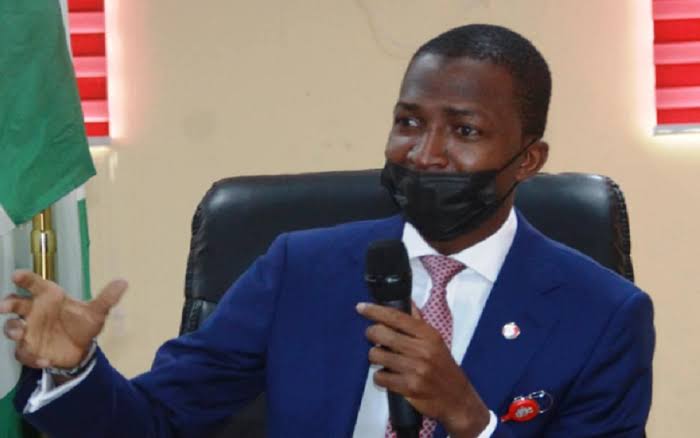
The Economic Financial Crimes Commission, (EFCC), has expressed concern about the country’s declining number of whistleblowers, despite rewards offered to informants.
The assertion was made by Abdulrasheed Bawa, Chairman of the Commission, on Thursday in Awka at a meeting on strengthening stakeholders’ capacity on whistleblowing policy, organized by the African Centre for Media and Information Literacy, AFRICMIL.
The MacArthur Foundation supported the program, which was co-hosted by the Anambra Civil Society Network, ACSONET, with the theme “Role of Community-Based Organizations in Entrenching Whistleblowing Policy at the Grassroots.”
Mr Bawa, who was represented by Oshodi Johnson, the EFCC’s Enugu Zonal Commander, stated that the whistleblowing policy had assisted the agency in recovering large sums of stolen public funds across the country.
He did, however, express concern that some obstacles were undermining the policy’s effectiveness in the country.
Some of the challenges, he claims, are ignorance of the policy’s legal and administrative frameworks, as well as difficulties and bureaucratic processes for claiming the advertised incentives.
“It is also not impossible that the few false informants or whistleblowers who were prosecuted for wanting to turn a serious programme to memes unnerved some other would-be informants.
“Whatever the challenges are, it is imperative that there is fresh awakening to sustain the flow of critical intelligence to Nigerian law enforcement agencies, ” he said.
Mr. Bawa stated that the Commission was dedicated to the success of the whistleblowing policy, calling it a critical component of the Federal Government’s anti-corruption framework.
He pledged to work with AFRICMIL and other community-based organizations to strengthen their capacity to identify and report suspected cases of corruption in their communities.
Kennedy Ebhotemen, Resident Anti-Corruption Commissioner at the Independent Corrupt Practices and Other Related Offences Commission, ICPC, Enugu, also spoke, claiming that corruption thrived in secrecy.
He urged the public to speak up and report any act of corruption or unethical behavior to anti-corruption agencies.
Chris Azor, Chairman of ACSONET, urged the EFCC and ICPC to establish offices in Anambra state to facilitate easy access to whistleblowers.
Earlier, AFRICMIL Coordinator Dr Chido Onumah stated that the whistleblowing policy had proven to be the most direct method of exposing corrupt acts.
Mr. Onumah, who was represented by Programs Manager Kolawole Ogunbiyi, identified early detection and exposure of mismanagement of public funds, bribery, fraud, theft of public funds, and other illicit acts as an effective strategy in the fight against corruption.
He said: “We all are aware that corruption thrives in multiple forms in our communities, but most visibly in the misappropriation of funds and abandonment of projects that could bring development and meaningfully turn around the lives of the people.
“We are both morally and legally bound as citizens not to keep silent about any act of corruption or wrongdoing whenever we see one”.