
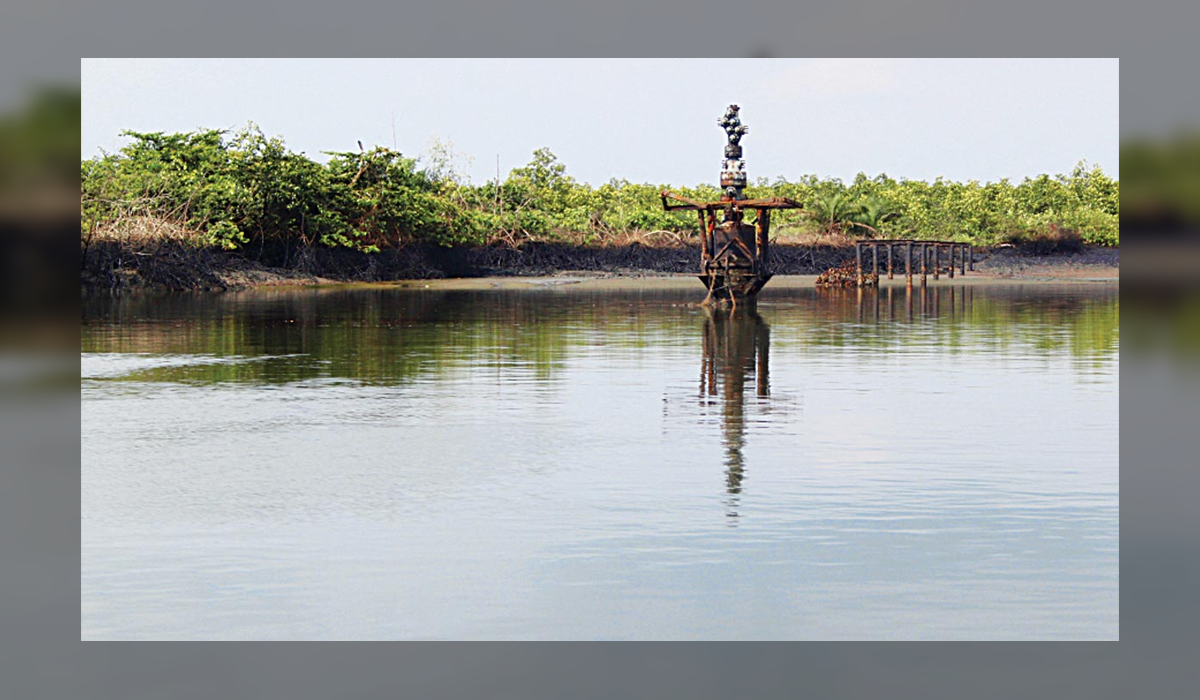
The Supreme Court ruled in favor of Rivers State in the ownership dispute over 17 oil-rich wells.
The apex court dismissed Imo State Government’s counter claim ownership in a judgment prepared by Justice Heleen Ogunwumiju and delivered by Justice Emmanuel Agim.
The oil wells in the territories of Rivers and Imo States had been the subject of litigation before the Supreme Court, which had a panel of seven Justices.
According to Justice Agim, the Court granted Rivers State Government reliefs 1, 3, 4, 5, and 6.
However, the Court refused to grant reliefs 2, 7, and 10.
Among the reliefs granted to Rivers by the Supreme Court is that the boundary between Rivers and Imo as delineated in Nigeria administrative maps 10th, 11th, and 12th editions, as well as other maps bearing similar delineation, are inaccurate, incorrect, and do not represent the legitimate and lawful boundaries between Rivers and Imo states.
The Supreme Court agreed with Rivers that the correct instruments, maps, and documents to be relied on in determining the boundary line between Rivers and Imo states were those used by Rivers in delineating the boundary line between the two states, including Decree No. 14 of 1967, Decree No. 12 of 1976, the White papers/conclusions of the Federal Military government on the Irikefe and the Nasir Boundary Commission/Boundary Adjustment Commission, the Eastern Nigeria map, Owerri Province map, Warri Province map, Onitsha Province map, Rivers Province map, Ahoada District map, and Aboh Division map, the Apex Court also declared that the boundary between Rivers and Imo states was determined using the correct instruments, maps, and documents, including Decree No. 14 of 1967, Decree No. 12 of 1976, the White papers/conclusions of the Federal Military Government on the Irikefe and the Nasir boundary Commission/boundary Adjustment Commission, the Eastern Nigeria map, the Provincial map of Owerri Province, Warri Province, Onitsha Province, Rivers Province, the Ahoada, The Rivers State communities wrongly attributed to Imo State, among others, are communities within Rivers State’s territorial boundaries, and thus communities over which Rivers State has governmental and administrative powers, including the right to benefits derived from mineral or other resources within the communities.
The apex court also made declaration that all the oil wells within Akri and Mbede communities usually identified with the names Akri and Mbede including the oil wells identified on Rivers map showing the location of oil wells wrongly attributed to Imo State including Akri 012, Akri 009, Akri 010, Akri 004, Akri West 002, Akri 001, Akri West 001, Akri 003, Akri 002, and Akri South 001, Mbede 017, Mbede 010, Mbede 019, Mbede 018, Mbede 002, Mbede 009, and Mbede 005 are all oil wells within the territory of Rivers State and form part of Rivers State and that it is only Rivers State that is entitled to receive the full allocation of the distributable revenue derived from the oil wells on the basis of the 13 percent derivation principle as provided for under Section 162 of the 1999 Constitution as amended, among others.
However, Justice Ogunwumiju refused to grant the N500m cost requested by Rivers State.
The Supreme Court also declined to order the AGF to calculate and refund to Rivers State all revenue that was wrongfully denied to the state and wrongfully paid to Imo state due to the extent of the distributable revenue derived from the Akri and Mbede oil wells.
The AGF and Imo state, who were the first and second defendants in the suit, had prayed the court on February 7 when they adopted their final processes to dismiss the suit and order Rivers to file it at the Federal High Court because it was a revenue matter.