
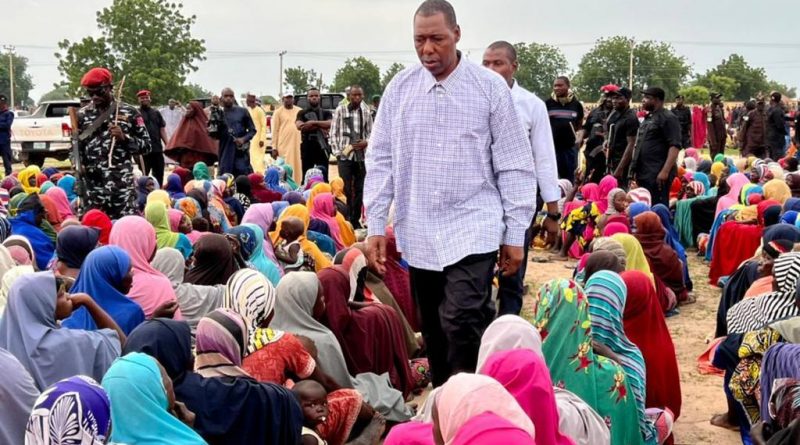
The United Nations has warned that worsening food insecurity could lead to the malnutrition of 1.74 million children under the age of five in North East Nigeria.
Mr. Matthias Schmale, the United Nations Resident and Humanitarian Coordinator for Nigeria, issued a statement on Tuesday titled: “Surviving the Food Crisis in North-east Nigeria,” said today in north-east Nigeria, millions of people are facing the painful consequences of a deteriorating food security and nutrition crisis. Schmale who explained that: “Food insecurity means not knowing when or where your next meal will come from. It means, in essence, not being able to meet the basic needs for yourself or your family. As a result, countless families are forced to make alarming sacrifices to survive. Many, particularly children, are at risk of not making it through the lean season.”
According to the most recent food security assessments, 4.1 million people in Borno, Adamawa, and Yobe States – three states in north-eastern Nigeria – are at risk of severe food insecurity during this lean season, he lamented:“People’s resilience and coping mechanisms have been devastated by more than a decade of conflict.”
He said: “As food insecurity worsens, so does the risk of malnutrition. In 2022, 1.74 million children under five are expected to suffer from acute malnutrition across the north-east. Mothers who have lost their children to malnutrition can testify to the danger it poses and the sorrow and despair it brings. While visiting a nutrition stabilization center in the north-east I saw the haunting sight of a child on the brink of death, and it is a memory that continues to leave me troubled.”
He noted that many factors are influencing the food security situation, including insecurity caused by ongoing conflict, rising food prices, and climate change, which is occurring in a region where people are already vulnerable. North-east Nigeria has endured 12 years of conflict and insecurity as a result of the violence of non-state armed groups such as Boko Haram.
He revealed that 8.4 million people require humanitarian assistance this year, with approximately 80% of them being women and children, and that the violence has displaced more than 2.2 million people. Livelihoods, health care, education, and other critical areas have been devastated, depriving millions of people of critical assistance and the ability to provide for themselves and their families.
He told the story of Hauwa, a mother from Rann, Borno State, who has no access to food and must beg on the street to feed herself and her two children, complaining that this is not nearly enough and that hunger has transformed her body into something she no longer recognizes.
“This is not my body,” Hauwa was quoted as saying. Is one of the numerous stories of suffering that have pervaded the area on a daily basis.
Schmale stated that the humanitarian community is deeply concerned about the millions of people who are at risk of going hungry this winter and the sacrifices they will make to survive. Every effort must be made to ensure that life-saving programs that provide food security assistance and respond to acute malnutrition continue to exist.
He emphasized that humanitarian and government actors are ready to scale up interventions, but funding is critical.
He stated that a $351 million multisector response has been developed as part of the USD$1.1 billion required for Nigeria’s 2022 Humanitarian Response Plan, noting that funds are urgently needed and that every contribution can make a difference.
He said: “You can help get life-saving assistance to the people of north-east Nigeria by donating at: https://crisisrelief.un.org/nigeria-crisis. We need your support now, tomorrow may be too late for Hauwa and countless others.”