
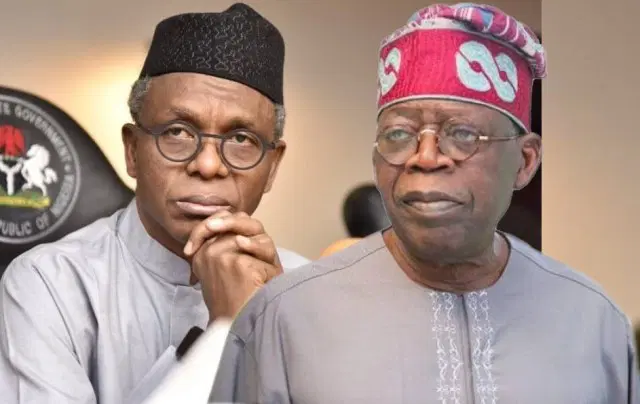
In a candid interview on Arise TV’s Prime Time on Tuesday, former Kaduna State governor Nasir El-Rufai made explosive claims about his exclusion from President Bola Tinubu’s ministerial list. He directly pointed the finger at Tinubu, dismissing suggestions that the National Assembly or security concerns played any role in his snub. “The National Assembly had nothing to do with it, the president didn’t want me in his cabinet,” El-Rufai stated unequivocally, challenging the official narrative surrounding his failed nomination.
A Personal Betrayal?
El-Rufai revealed a backstory of political negotiations and broken promises. He disclosed that Tinubu had personally sought his support after El-Rufai left office, publicly urging him to back the president’s agenda. “The president begged me publicly to support him, I said I would and I don’t want anything,” he recounted. What followed was two months of discussions, culminating in an agreement: Tinubu would nominate him as a minister, with certain conditions attached. However, El-Rufai alleged that Tinubu later reneged on this deal. “Along the line, either the president changed his mind,” he said, suggesting a shift in Tinubu’s stance that derailed his appointment. He emphasized his self-reliance, adding, “I am a self-made man, I don’t need anything,” positioning himself as someone who entered the arrangement on principle, not desperation.
Debunking the Security Concerns Narrative
El-Rufai also took aim at the claim that his exclusion stemmed from security issues flagged by the Senate. He challenged the administration to substantiate this excuse, asking, “What was the security issue the National Assembly had against me? Where is the report?” He argued that no such evidence exists, pointing out that less qualified and less experienced nominees cleared the screening process—implying that presidential influence, not security vetting, determined outcomes. “There were far less qualified, less experienced that scaled through because the president made a call,” he noted, acknowledging Tinubu’s prerogative with a wry, “He’s a human being—he’s entitled to change his mind.”
A Broader Critique of the APC
Beyond his personal grievance, El-Rufai leveled a sharp critique at the All Progressives Congress (APC), a party he helped found. He expressed dismay at its current state under Tinubu’s leadership, stating, “Two years after the election of President Tinubu, none of the party organs is functioning. The progressive ideals are not being pursued with any vigour.” As a founding member who “sacrificed a lot” to build the APC into an internally democratic and reform-driven party, El-Rufai lamented its stagnation, signaling deeper concerns about its direction and management.
Political Implications
El-Rufai’s remarks are more than a personal defense—they’re a calculated strike at Tinubu’s credibility and the APC’s cohesion. By framing his exclusion as a presidential decision, dismissing security concerns as a smokescreen, and calling out the party’s drift, he’s positioning himself as a formidable voice of dissent. Whether this is a prelude to a larger political maneuver or simply a public airing of grievances, El-Rufai’s words underscore tensions within the APC as Nigeria’s political landscape braces for the 2027 elections. One thing is certain: this seasoned politician isn’t stepping back quietly.