
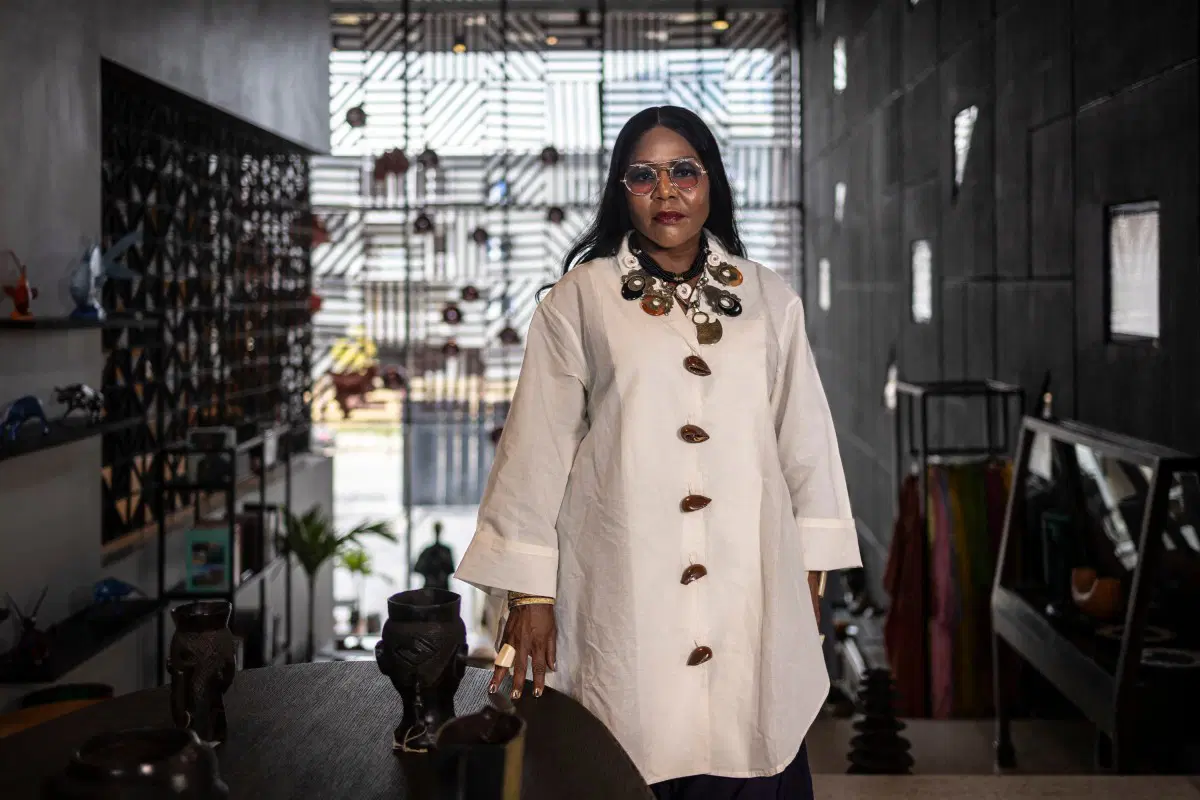
Its modernist façade — clad in latticework inspired by Yoruba adire textiles — makes Alara an arresting presence in Lagos, Nigeria’s commercial capital. A decade after it opened, the fashion and design “concept store” has become a symbol of what founder Reni Folawiyo calls “Afro-lux”: a celebration of African creativity presented on equal footing with the world’s biggest brands.
Inside the striking structure, upscale African fashion labels share space with Western brands, contemporary art, and books. For Folawiyo, 60, the aim has always been to elevate design from the continent and to ensure that rural craftsmanship — often overlooked — is recognised as valuable.
“A lot of the beautiful things people were making in different parts of Africa were not celebrated in the way they should,” she told AFP. “I felt very strongly that these objects and these people had value.”
Music, Museums and Global Spotlight
African fashion has gained global visibility in recent years, propelled in part by West Africa’s music stars. In May, Burna Boy, Tems, and Ayra Starr attended the Met Gala in New York wearing outfits by British-Ghanaian designer Ozwald Boateng.
But Folawiyo insists the industry must go beyond red carpets. “At the moment, the best way to platform designers outside Africa is to partner and collaborate with institutions of repute,” she said, citing Alara’s recent pop-up at the Brooklyn Museum and a collaboration with the Los Angeles County Museum of Art.
Her inspirations extend across the continent: from Yoruba colour and ceremony to the rugged aesthetics of Senegal and the refined design traditions of Ivory Coast.
Fashion Meets Food
Behind the store lies NOK, a restaurant led by celebrated Senegalese chef Pierre Thiam. Its menu, like Alara’s curation, brings West African creativity into global conversations — though at more accessible price points than the boutique itself.
Inside Alara, a green dress by Nigerian brand Eki Kere sells for about ₦325,000 ($210), while a table from Senegalese-Nigerian studio Salu Iwadi can fetch ten times more. The store caters to Nigeria’s elite — oil executives, tech entrepreneurs, and international clients — even as the country’s middle class grapples with inflation.
From Lagos to the World
Folawiyo, daughter of former Western Region attorney general Lateef Adegbite and wife of businessman Tunde Folawiyo, admits her vision was initially difficult to sell to investors. “But I was very committed to it and had great belief in myself and my idea,” she said.
A decade later, Alara has outgrown its Lagos base. Folawiyo stages shows abroad, most recently at CARIFESTA XV in Barbados, and continues to push for knowledge-sharing to sustain the industry.
“Ultimately,” she said, “success depends on passing on knowledge to future generations.”