
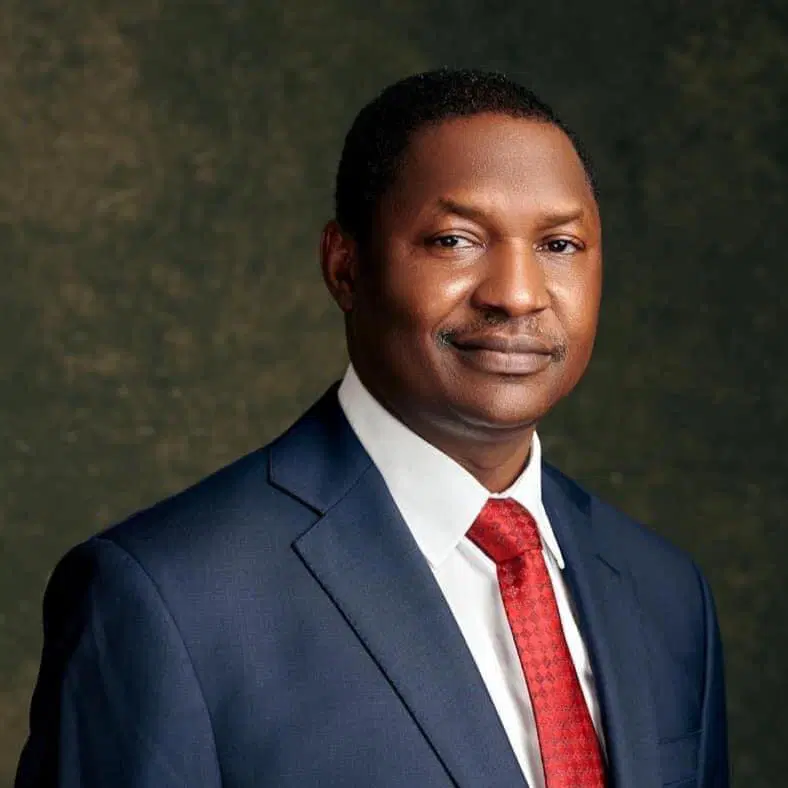
Former Attorney-General of the Federation and Minister of Justice, Abubakar Malami, has welcomed Nigeria’s victory in the arbitration dispute over the Mambilla Hydroelectric Power Project, while calling for transparency in interpreting the tribunal’s findings concerning his role in the matter.
An International Chamber of Commerce (ICC) arbitration tribunal in Paris recently rejected claims by Sunrise Power and Transmission Company Limited against Nigeria, including demands running into hundreds of millions of dollars linked to a 2020 settlement agreement.
The tribunal’s 616-page final award, however, reportedly contained serious findings concerning Malami’s handling of the settlement negotiations, including an alleged corrupt arrangement involving him and Sunrise promoter, Leno Adesanya.
In a statement signed by his media aide, Bello Doka, Malami said Nigeria’s protection from substantial financial exposure was an outcome every patriotic Nigerian should welcome, regardless of political affiliation.
He urged the public, however, to distinguish between the outcome of an international commercial arbitration, findings made in determining contractual claims and a criminal conviction against an individual.
“The award does not constitute a criminal conviction of him,” Doka said.
Malami’s office acknowledged reports of serious findings concerning the settlement and its addendum, presidential approval, communications between Malami and Adesanya, and an alleged corrupt arrangement.
Doka said the findings should neither be ignored nor trivialised, but considered against the complete evidentiary and documentary record rather than selected passages circulating in the media.
He said Malami’s office would issue a comprehensive response after reviewing the full award and underlying records.
The former AGF’s office also argued that the Mambilla controversy long predated Malami’s tenure, tracing the contractual dispute to 2003, when Sunrise became involved in the proposed hydroelectric project.
According to Doka, the dispute passed through successive administrations, Attorneys-General, ministries and contractual arrangements before Malami became Attorney-General.
He also cited a 2012 General Project Execution Agreement involving Sunrise and Sinohydro, as well as a directive communicated by the Chief of Staff to then-President Muhammadu Buhari in April 2016 concerning outstanding disputes and competing interests surrounding the project.
Doka said Malami, as Attorney-General and chief legal officer of the Federation, was required to advise the government on its legal exposure and possible ways of resolving the disputes.
On the controversial $200 million settlement, Doka said public discussion should distinguish between whether the terms were acceptable and why a settlement was being considered in the first place.
He said Sunrise had initially presented claims running into billions of dollars and proposed $500 million as a full and final settlement during negotiations in London in November 2019.
Federal Government representatives, according to Doka, countered with $100 million before negotiations produced a $200 million figure.
He said the government was considering whether a potentially multibillion-dollar exposure, prolonged litigation, financing difficulties and delays to the Mambilla project could be resolved through a substantially smaller settlement.
Buhari ultimately declined to approve the proposed $200 million payment.
Doka said the former President indicated on April 20, 2020, that the Federal Government did not have the funds to pay Sunrise, a position Malami communicated to the company two days later.
He also referred to a January 2021 request for presidential approval, which reports on the tribunal award said Buhari rejected with the words, “Not approved.”
According to Doka, Malami subsequently directed counsel representing the Federal Government to resist Sunrise’s attempt to enforce the settlement against Nigeria.
On the tribunal’s reported finding of a corrupt arrangement between Malami and Adesanya, Doka said the former minister rejected any suggestion that his official actions were undertaken in exchange for personal financial benefit.
He argued that the allegation should be assessed against the complete evidentiary record.
Doka also questioned reports that Adesanya claimed to possess audio and video recordings relevant to the allegations but did not produce them before the tribunal, saying the existence, authenticity and contents of any such recordings were matters of evidentiary significance.
The tribunal, however, reportedly found evidence of an unlawful arrangement involving Malami and Adesanya while rejecting Sunrise’s claims against Nigeria. It also held that the settlement agreement and addendum were not binding on Nigeria because they lacked the required presidential approval and were unenforceable on public-policy grounds.
Doka maintained that the arbitration award should not be characterised as a criminal conviction of Malami because the proceedings