
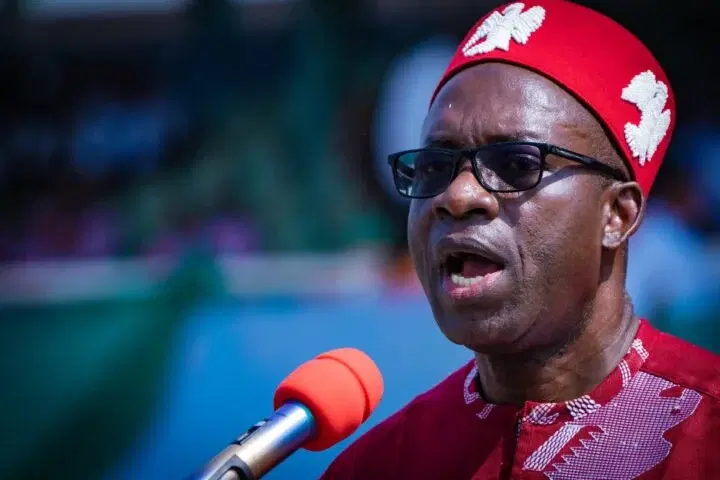
Governor of Anambra State and former Central Bank of Nigeria (CBN) governor, Prof. Charles Soludo, has cautioned the Independent National Electoral Commission (INEC) against moves to restrict its authority to review election results, warning that such an amendment could weaken accountability and entrench impunity.
Speaking virtually at the Athena Centre’s Review of INEC’s Innovation in Electoral Technology (2015–2025), Soludo commended INEC’s technological progress but raised concern over a reported proposal to amend Section 64 of the Electoral Act.
Under the existing law, INEC can review results declared under duress or in violation of the Electoral Act or its own guidelines. However, Soludo noted that the proposed amendment would limit this power to cases involving duress only.
“How problematic is that,” he asked, “when Nigerians have been calling for more measures to address impunity on the part of politicians who undermine the electoral process?”
The governor questioned why INEC would seek to restrict its ability to review flawed results, particularly in situations where collation officers have openly breached established procedures.
“When we have seen instances where collation officers declared results contrary to INEC’s guidelines, it seems perverse to protect such officials when they violate the law,” Soludo said.
While acknowledging concerns that a broader review mandate could burden INEC with matters better suited for the courts, Soludo maintained that the process must still be strong enough to ensure accountability within the commission itself.
He urged for legal mechanisms that would prosecute and jail any INEC official found to have signed off on falsified or improperly collated results.
“Until we jail one, two, three, four faulty prosecutors, there are still enough people in this country who care for their name and who don’t want to go to jail, whatever the amount of money they have to give to compromise the process,” he stated.
Soludo lamented what he described as a cycle in which erring officials are redeployed to replicate the same malpractice elsewhere, calling it “the root of the problem.”
He also emphasised the need for total transparency in the electoral process, envisioning a system where candidates win elections purely on merit.
“In my dream electoral system, politicians do not need to know any INEC staff or security agents to win. The results are declared, and they win if the people want them to win,” he said.
To reach that ideal, Soludo called on political parties to remain “eternally vigilant,” citing an example where alert party agents prevented the use of pre-filled ballot papers during a recent by-election.
He also urged a thorough assessment of the role of security agents in elections, insisting that the process should be free from external manipulation.
While cautioning against portraying Nigeria’s electoral evolution as either entirely good or bad, the governor noted that the system had recorded measurable progress.
Recalling the tenure of former INEC Chairman, Prof. Attahiru Jega, Soludo pointed to the 2015 election in which an incumbent government lost and peacefully conceded as proof of institutional progress.
“We’ve seen the good and the bad. Those who appointed sometimes lose woefully. That’s progress,” he said.
He, however, called for sustained reforms and vigilance. “It’s a work in progress,” Soludo said. “We can make much more progress—and faster too—but we must never forget where we are coming from or where we need to go.”